







A Saudi-engineered solution at the intersection of edge AI, national security, and Vision 2030 digital transformation
Published: 2025 • Engineered in Jeddah, Saudi Arabia • Sector: AI / Smart Cities / Public Safety
1. Introduction: The Surveillance Imperative of Vision 2030
Saudi Arabia is in the midst of one of the most ambitious national transformation programs in modern history. Vision 2030, the Kingdom’s sweeping strategic framework championed by Crown Prince Mohammed bin Salman, seeks to diversify the economy beyond oil, build a vibrant knowledge society, and position the Kingdom as a global hub for technology and innovation. Central to this mission is the digitization of public infrastructure — and nowhere is that imperative more acute than in public safety and urban surveillance.
For decades, urban security relied on passive closed-circuit television (CCTV) systems: cameras that recorded footage diligently but provided zero operational intelligence. Operators were overwhelmed, incidents went undetected, and reams of video data sat idle on servers. This paradigm is now being dismantled — not through expensive infrastructure overhauls — but through intelligent software and hardware that transforms existing cameras into active, thinking sensors.

Into this landscape steps Falcon Eye, an AI-powered video surveillance system designed and engineered in Jeddah, Saudi Arabia, by Alwajeez Tech. Unlike conventional upgrades that require replacing entire NVR (Network Video Recorder) ecosystems, Falcon Eye is a hardware-accelerated edge AI device that connects directly to existing infrastructure via standard RTSP and ONVIF protocols. The result: real-time, actionable intelligence from cameras already in place — at a fraction of the cost of legacy overhaul approaches.
This article examines Falcon Eye’s technical architecture, its alignment with Saudi Arabia’s national AI and smart city strategy under SDAIA, the market conditions that make it timely, and the challenges it must navigate in a rapidly evolving competitive landscape.
| Key InsightThe global shift from passive CCTV to proactive AI surveillance is not merely a technology upgrade — it is a fundamental reimagining of what public safety infrastructure can deliver. Falcon Eye represents Saudi Arabia’s answer to that challenge, built for local conditions, from local soil. |
2. What is Falcon Eye? Core Technology and Capabilities
2.1 The Problem: Legacy Surveillance’s Blind Spot
Traditional NVR systems are fundamentally reactive. They capture and store video footage, but the process of reviewing, flagging, and acting on that footage depends almost entirely on human operators monitoring screens in real time — a task that is physiologically exhausting, operationally expensive, and inherently error-prone. Studies consistently show that human attention degrades sharply after 20 minutes of continuous monitoring, making traditional CCTV control rooms vulnerable to precisely the kind of incidents they are designed to catch.
In high-density urban environments — the types Saudi Arabia is building across Riyadh, Jeddah, NEOM, and Qiddiya — the scale of surveillance infrastructure is growing faster than the human capacity to monitor it. The result is a paradox: more cameras, but not necessarily more effective security.
2.2 The Solution: Falcon Eye’s Architecture
Falcon Eye resolves this paradox through a three-layer architecture that combines on-device edge AI, cloud-based deep classification, and a purpose-built operational dashboard:
- Layer 1 — Edge AI Inference: A Hailo-8L Neural Processing Unit (NPU), delivering 13 TOPS of AI performance, runs real-time object detection directly on the device at 25–30 frames per second. This eliminates the latency and bandwidth costs of cloud-only processing.
- Layer 2 — Hybrid Cloud Intelligence: When the edge model encounters ambiguous or unusual vehicles — a common occurrence in the GCC, where pickup configurations and utility vehicles differ from the datasets on which most global models are trained — Falcon Eye routes those frames to Google’s Gemini Vision AI for deep classification. This hybrid model preserves speed for standard detections while ensuring accuracy for edge cases.
- Layer 3 — Operational Dashboard: The system outputs live data to an industrial-grade control room interface, designed in dark mode with orange and amber accents — a UI standard optimized for 24/7 operator environments to reduce eye strain and maximize data legibility.
2.3 Connectivity: No Rip-and-Replace Required
Perhaps Falcon Eye’s most commercially significant feature is its backward compatibility. The device connects to existing NVR systems and IP cameras from Hikvision, Dahua, Uniview, Axis, Hanwha, and any other manufacturer that supports standard RTSP streams. Organizations that have already invested in camera infrastructure do not need to start from scratch — they simply add Falcon Eye to their existing network, and their passive recording infrastructure becomes an active intelligence layer.
This approach dramatically reduces deployment costs and shortens implementation timelines. For municipalities, government agencies, and large facilities considering surveillance upgrades, the absence of a rip-and-replace requirement is often the decisive factor in a procurement decision.
2.4 Real-Time Traffic and Vehicle Intelligence
In its initial configuration, Falcon Eye is specialized for vehicular intelligence — detecting, classifying, and counting cars, trucks, buses, and motorcycles in real time. The operational dashboard provides live telemetry charts, multi-class vehicle counting, and event-driven alerts via MQTT, REST API, and WebSocket feeds, enabling seamless integration with city-level traffic management platforms and SCADA systems.
3. Technical Specifications
The following table summarizes Falcon Eye’s key technical parameters as designed and deployed by Alwajeez Tech:
| Feature | Specification |
|---|---|
| Processing Unit | Raspberry Pi 5 (8GB RAM) + AI HAT+ 2 (Hailo-8L NPU) |
| AI Performance | 13 TOPS (Tera Operations Per Second) |
| Input Protocols | RTSP (H.264/H.265), ONVIF Profile S & T |
| Supported NVR Brands | Hikvision, Dahua, Uniview, Axis, Hanwha (any standard RTSP stream) |
| Concurrent Streams | Up to 4–6 HD streams simultaneously |
| Detection Frame Rate | 25–30 FPS real-time via on-device NPU |
| Output & Integration | MQTT (JSON Events), REST API, WebSocket Live Feed |
| Installation | DIN Rail / Desktop, Ethernet connection |
| Cloud AI Fallback | Google Gemini Vision AI for deep vehicle classification |
| UI Design | Industrial dark mode with orange/amber accents for 24/7 control rooms |
The choice of the Raspberry Pi 5 platform — while unconventional for enterprise applications — is deliberate. The Pi 5 provides a mature, well-documented software ecosystem, low power consumption, and a small form factor ideal for DIN rail installation inside existing NVR cabinet infrastructure. Paired with the Hailo-8L AI HAT+, it achieves inference performance that rivals dedicated AI edge servers at a fraction of the cost, making it particularly well-suited for mid-tier municipal and commercial deployments.
4. Falcon Eye vs. Traditional NVR Systems
The operational differences between Falcon Eye’s AI-augmented architecture and conventional NVR deployments are substantial, spanning functionality, cost structure, and actionable intelligence:
| Capability | Traditional NVR System | Falcon Eye (Alwajeez Tech) |
|---|---|---|
| Real-Time Incident Alerts | ✗ Not available | ✓ Instant alerts via MQTT/WebSocket |
| Vehicle Classification | ✗ None | ✓ Multi-class: car, truck, bus, motorcycle |
| GCC Vehicle Recognition | ✗ Generic global models | ✓ Hailo NPU + Gemini fallback for local vehicles |
| Hardware Replacement | Requires full rip-and-replace | ✓ Connects to existing NVRs via RTSP/ONVIF |
| Operational Intelligence | ✗ Zero — passive recording only | ✓ Live telemetry, traffic data dashboards |
| Processing Location | Cloud-dependent or none | ✓ On-device edge AI (25–30 FPS) |
| Control Room Interface | ✗ Basic playback UI | ✓ Industrial dark-mode dashboard |
| Cost Efficiency | High (operator headcount) | ✓ Automated monitoring, lower TCO |
5. Engineered in Jeddah: GCC-Specific Adaptation
One of the most frequently overlooked challenges in deploying commercial AI surveillance systems in the Gulf region is dataset bias. Most commercial computer vision models — including widely used COCO-trained models — are trained predominantly on North American and European imagery. This creates a significant accuracy deficit when deployed in GCC environments, where vehicle types, configurations, and proportions differ meaningfully from training data.
Prominent examples include the Toyota Land Cruiser, Nissan Patrol, and Toyota Hilux — ubiquitous vehicles across Saudi Arabia and the wider GCC that are systematically misclassified by standard global models. A misclassified vehicle in a traffic management or law enforcement context is not a minor inaccuracy — it can corrupt incident reports, skew traffic analytics, and undermine trust in the system.
| GCC-Specific DesignFalcon Eye’s hybrid intelligence model addresses this directly: the on-device Hailo NPU handles high-confidence detections, while the Gemini Vision AI fallback layer is specifically configured to recognize GCC-specific vehicle classes. This locally-optimized approach is a direct competitive advantage over international solutions deployed without regional customization. |
Designed and engineered in Jeddah, Alwajeez Tech brings an insider’s understanding of Saudi market conditions — not just vehicle types, but the operational rhythms of Saudi control rooms, the integration requirements of local NVR deployments, and the regulatory context under which surveillance data must be managed. This is the advantage that ‘engineered in Jeddah’ confers: not patriotism as a feature, but genuine product-market fit built from proximity.
6. Saudi Vision 2030: The National Imperative for AI Surveillance
6.1 SDAIA’s Central Role
The Saudi Data and Artificial Intelligence Authority (SDAIA — الهيئة السعودية للبيانات والذكاء الاصطناعي) was established as the Kingdom’s institutional backbone for AI adoption. SDAIA’s mandate encompasses the secure deployment of AI to enhance quality of life, oversee data governance, and advance the National Strategy for Data and AI (NSDAI). It operates as both a regulatory body and an active implementer of smart city AI infrastructure.
SDAIA has established the Smart Riyadh Operations Center (Smart ROC), a centralized command infrastructure that uses data and AI to monitor, analyze, and forecast operational indicators across multiple city sectors simultaneously — representing exactly the kind of integrated intelligence layer that systems like Falcon Eye are architectured to feed.
6.2 Riyadh’s Smart Surveillance Infrastructure
Riyadh Municipality has deployed over 1,600 AI-powered cameras across parks and public plazas as part of its smart city program. These cameras go far beyond passive recording: they automatically detect abnormal behaviors including medical emergencies such as fainting, child safety incidents, unauthorized gatherings, acts of vandalism, and fire violations. Detection triggers immediate alerts to response teams, dramatically reducing emergency response times.
This operational precedent — AI cameras as active safety infrastructure, not passive recorders — is precisely the use case Falcon Eye is built to serve, and it validates the commercial thesis that AI-augmented surveillance is becoming standard infrastructure rather than a premium add-on.
6.3 Hajj Safety and Pilgrimage Management
Saudi Arabia manages the world’s largest annual mass gatherings at the Two Holy Mosques in Makkah and Madinah, serving over two million pilgrims during the Hajj season. The Kingdom has deployed AI-powered platforms — including the ‘Sawaher’ system — that leverage high-resolution satellite imagery, IoT sensor networks, and real-time crowd analytics to manage pilgrim flows, identify congestion points, and prevent crowd crush incidents.
The Sawaher system also performs detailed traffic analysis — identifying accident hotspots, modeling flow disruptions, and providing decision-makers with predictive insights. This is precisely the analytical pipeline that edge AI surveillance systems like Falcon Eye are designed to feed, suggesting significant integration potential in future pilgrimage management infrastructure.
6.4 SDAIA’s ‘Smart C’ Urban Intelligence Platform
SDAIA’s ‘Smart C’ platform represents the Kingdom’s ambition for unified urban intelligence: a single analytical layer that monitors, analyzes, and predicts operational indicators across transportation, utilities, public safety, and environmental sectors. Feeding this platform with real-time, AI-processed data from the Kingdom’s expanding camera networks is a core infrastructure challenge — and one that distributed edge AI devices are uniquely positioned to address.
6.5 Cybersecurity and Data Governance
The National Cybersecurity Authority (NCA) and SDAIA jointly govern the data security framework within which AI surveillance systems must operate. Saudi Arabia’s Personal Data Protection Law (PDPL) establishes requirements for data minimization, purpose limitation, and consent that apply directly to video surveillance deployments. Any surveillance system operating in the Kingdom must demonstrate compliance with these frameworks — a bar that locally-engineered solutions like Falcon Eye are positioned to meet more naturally than international products designed for different regulatory environments.
7. Vision 2030 AI Surveillance Milestones
The following timeline captures key developments in Saudi Arabia’s AI surveillance and smart city journey:
| Year | Milestone |
|---|---|
| 2016 | Saudi Vision 2030 launched; digital transformation of public services begins |
| 2019 | SDAIA established as national authority for data and AI governance |
| 2020 | National Strategy for Data and AI (NSDAI) published; AI surveillance frameworks initiated |
| 2021 | Riyadh Smart Surveillance System: 1,600+ AI cameras deployed in public spaces |
| 2022 | Sawaher platform deployed for Hajj crowd management using satellite AI and IoT |
| 2023 | Smart ROC (Riyadh Operations Center) operationalized; NEOM AI infrastructure contracts awarded |
| 2024 | Pilotless air taxi trials during Hajj; drone surveillance integration across giga-projects |
| 2025 | Alwajeez Tech launches Falcon Eye — Saudi-engineered edge AI surveillance platform from Jeddah |
| 2030 | Target: AI and smart tech integrated into 30% of all new urban developments across the Kingdom |
8. Market Landscape and Investment Context
The commercial opportunity for AI-powered surveillance in Saudi Arabia is substantial and accelerating. The following table summarizes the key market metrics:
| Metric | Value |
|---|---|
| Smart City AI Traffic Safety Market | USD 1.2 billion (current) |
| Saudi AI Market (2025) | USD 1.24 billion |
| Saudi AI Market (2034 projected) | USD 4.37 billion |
| Giga-Projects Investment | Over USD 500 billion (NEOM, Qiddiya, Red Sea Global) |
| Smart Surveillance Cameras (Riyadh) | Over 1,600 AI-powered cameras deployed |
| Urban Population (projected) | 36 million (near-term) |
| Smart Tech in New Developments | 30% integration target |
Several structural forces are converging to make this one of the most dynamic AI infrastructure markets in the world. First, the sheer scale of the Kingdom’s giga-projects — NEOM, Qiddiya, Red Sea Global, and Diriyah Gate — demands purpose-built smart city surveillance infrastructure that does not yet exist at scale. Second, rapid urbanization is concentrating population in fewer, larger metropolitan centers, amplifying the operational load on traditional surveillance systems. Third, the Saudi government’s explicit commitment to integrating smart technologies into 30% of new urban developments provides a policy floor beneath which the market cannot contract.
Against this backdrop, Falcon Eye enters a market with few locally-engineered alternatives. International players — Huawei, Siemens, Genetec, Milestone Systems — offer sophisticated platforms but lack the regional specificity, regulatory familiarity, and local support infrastructure that a homegrown Saudi solution provides. The Saudi government’s broader policy of supporting domestic technology development — including through SDAIA’s incubation programs and the National Technology Development Program — creates additional tailwinds for locally-built solutions.
9. Challenges and Considerations
9.1 Integration with Legacy and Heterogeneous Infrastructure
While Falcon Eye’s RTSP/ONVIF compatibility provides a strong baseline for interoperability, real-world deployments frequently encounter proprietary firmware limitations, network segmentation issues, and non-standard stream configurations. Large municipal deployments may involve hundreds of NVR models across multiple generations, requiring careful compatibility validation and ongoing firmware management.
9.2 Data Privacy and Regulatory Compliance
Saudi Arabia’s Personal Data Protection Law (PDPL) and SDAIA’s data governance frameworks impose requirements that surveillance operators must navigate carefully. Video data from public spaces, particularly when processed by AI systems that generate behavioral profiles or vehicle tracking data, intersects with the PDPL’s scope. Organizations deploying Falcon Eye must implement appropriate data retention policies, access controls, and — where applicable — consent mechanisms for non-public spaces.
9.3 Edge-Cloud Balance and Connectivity
Falcon Eye’s hybrid architecture depends on reliable connectivity for its Gemini Vision AI fallback layer. In locations with intermittent or bandwidth-constrained connectivity — remote giga-project construction sites, peripheral urban zones, or high-density event venues — the cloud classification layer may face latency or availability challenges. Expanding the on-device model’s capability to reduce cloud dependency over time will be an important product development priority.
9.4 International Competition
The Saudi smart city market has attracted attention from global technology giants including Huawei (which has significant existing infrastructure relationships in the Kingdom), Siemens, IBM, and specialist AI surveillance vendors like Genetec, Milestone Systems, and Avigilon. These players bring significant R&D budgets, established enterprise sales organizations, and — in some cases — existing government procurement relationships. Alwajeez Tech’s competitive response must leverage its regional specificity, lower total cost of ownership, and alignment with Saudi localization preferences as durable differentiators.
10. Future Outlook
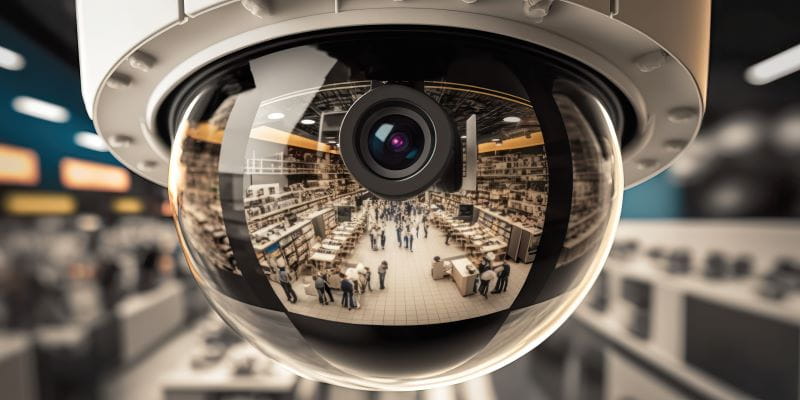
The trajectory of AI surveillance in Saudi Arabia points toward increasing capability, deeper integration, and broader sectoral reach. Several developments are likely to shape Falcon Eye’s evolution and the broader market over the next five years:
- Vertical Diversification — Sectoral Expansion: Having established a foundation in traffic and vehicle intelligence, Alwajeez Tech is positioned to extend Falcon Eye’s capabilities into retail (footfall analytics, loss prevention), logistics (warehouse and port perimeter security), healthcare (patient safety monitoring), and educational campuses — each representing a distinct vertical with different regulatory and operational requirements.
- Sensor Fusion — Drone and IoT Integration: SDAIA’s smart city frameworks explicitly envision AI surveillance as part of a multi-sensor ecosystem including drones, environmental IoT sensors, and satellite imagery. Falcon Eye’s MQTT and REST API output architecture is well-suited for integration into these broader data pipelines, enabling richer situational awareness than camera-only systems can provide.
- Generative AI Enhancement — Generative AI and Predictive Analytics: The integration of large language models and generative AI into surveillance analytics — enabling natural-language querying of surveillance databases, automated incident reporting, and predictive risk modeling — represents a near-term enhancement opportunity. Falcon Eye’s existing Gemini integration provides a foundation for expanding this capability.
- Policy Alignment — Support for Saudi Localization Policy (Vision Realization): The Saudi government’s ‘Vision Realization Programs’ actively prioritize domestic technology sourcing. As procurement criteria increasingly weight local content, Saudi-engineered solutions like Falcon Eye gain structural advantages that compound over time.
- Standardization — Smart City Standardization: As SDAIA’s Smart C platform matures and establishes data interchange standards for urban surveillance feeds, solutions that natively comply with those standards — and that can demonstrate integration with existing ROC infrastructure — will be preferred vendors. Alwajeez Tech’s proximity to the Saudi regulatory ecosystem positions it to anticipate and shape these standards.
11. Conclusion
Falcon Eye is more than a surveillance product. It is a statement about where Saudi technology is heading: toward locally-engineered, regionally-optimized, AI-native solutions that can compete on technical merit with international alternatives while offering the regulatory familiarity, cultural alignment, and product-market fit that only a domestic company can provide.
By combining the efficiency of edge AI — real-time inference at 25–30 FPS without cloud dependency for standard detections — with the accuracy of cloud-based deep classification for GCC-specific edge cases, Falcon Eye strikes a pragmatic balance between performance and cost. Its backward-compatible architecture, which activates intelligence from existing NVR infrastructure without requiring replacement, positions it as a high-ROI upgrade path for municipalities, government agencies, and commercial operators across the Kingdom.
Within the framework of Saudi Vision 2030, SDAIA’s national AI strategy, and the Kingdom’s giga-project-driven smart city ambitions, Falcon Eye represents the kind of technology that Vision 2030 was designed to cultivate: innovative, Saudi-built, globally competitive, and in direct service of a safer, smarter, more data-driven Kingdom.
As the Saudi AI market grows from USD 1.24 billion today toward a projected USD 4.37 billion by 2034, and as the Kingdom’s smart city investments scale toward their Vision 2030 targets, the demand for systems that think — not just record — will only intensify. Alwajeez Tech has positioned Falcon Eye to meet that demand, from Jeddah, for the Kingdom and beyond.